
I’m sure by now you would have heard that my base in Rockhampton has had issues relating to Tropical Cyclone Marcia. Up until last week everything looked to be on track, the fitness levels were continuing to improve, the speed in my workouts were increasing to levels I hadn’t experienced in the past, and the mind was psyched to put on a show in just over 6 weeks time in Canberra. Then came the wind, rain, fallen trees and power lines and a focus on town recovery rather than individual goals understandably took the focus.
This is the first and hopefully last time my training pattern will be disrupted by something that can’t be foreseen, and frustratingly there really isn’t anything that could be done. With no power in the bulk of the town for a week it simply wasn’t safe in terms of lighting and debris to run anywhere, and in reality running would just get in the way of those looking to do the best job in restoring the services needed for a town to function. Fortunately that has now changed so I can resume preparations.
Normally for runners a week off is often taken to recover from a niggle or more serious muscular injury. That is something that has caused me problems in August last year in particular, where the recovery from the City2Surf in Sydney took longer than desired (not helped by aggravating an injury training for a last football game). So far I’ve been lucky this year to avoid major strains, although there will be some nervousness when I resume, knowing that the need to ease back into training is something I often struggle with.
With this disruption a change in the training program has to happen. It was hoped that this week I would have the endurance base to run beyond 2 hours on Saturday Morning which I’ve been using as a long run. However I may have to be content running for about 90 minutes instead, with a bigger increase for the next couple of weekends leading into the Twilight Run in less than a month. I also hoped to run for longer distances incorporating hills, especially after a sub par effort in my most recent training run prior to the cyclone. Maybe I’ll have to be content with running not more than an hour or 75 minutes instead, at least in the short term. What also doesn’t help is that that area of town is most affected by power cuts so any run on the courses I use may have to wait a little longer.
Despite all of this the weight has been kept well under control, partially because of the lack of food options and partially due to the need to make smaller purchases. Hopefully the fact that the power has been restored means that I don’t go over the top in terms of food intake. If I can control the weight to around the 87kg mark (I’ve been closer to 88-89 kg for the bulk of the year) then the training should be easier and the fitness levels won’t take so long to regain.
There are no plans to alter the schedule I’ve set out in the short term. Accommodation has been booked for the events in March and April, and flights will be 100% confirmed in a fortnight with only the return trip from Canberra to book. With the issues beyond my control seemingly past us, hopefully now I can look forward to getting back in the swing of things!
First of all apologies for not posting on here for a while. Perhaps the break has done us all good, maybe the anxiety of waiting for me to post has become too much to bear. But never fear, I’m back in business now that the training has begun for the early events of 2015.
Most of the preparation many see through twitter, facebook and instagram posts tends to look after the physical side of training. Normally people see the various apps acting as a training log (I’ll post a shorter training schedule in a couple of weeks, more when that time comes upon us), pictures of training venues, and even the obligatory snap of someone eating a post workout frozen yoghurt drowned in 15 different toppings. Today I’m going to focus on the side many don’t really see, the logistical preparations. Unless you reach elite status, which barring miracles won’t happen to me or many of the readers, simply planning for the entire trip for running events can be a nightmare.
It’s generally not so bad if you live in the big cities, where you may find several events within easy reach of either your driving capabilities or public transport. Of course some cities such as Melbourne drop the ball when it comes to getting to Sunday Morning events, so planning ahead for that is a key element. For those that live in the regions and country outposts, it does get trickier and expensive, for there may be only one or two events a year. So for a typical event, there are a few elements that need to be considered.
– TRAVEL: Going by air, road (car or bus) or train. Consideration has to go to costs, generally up here the train is often as cheap as the plane, but there may be only 1 or 2 chances to catch a train to head into the big city in order to make an event as opposed to anywhere between 5 and 7 flights depending on carrier. For events further away from the nearest Capital city, you may even look for a combination of transport options or even a combination of airlines for the bigger cities may have multiple businesses flying the same route. For example to get from Brisbane to Melbourne, you could choose any of 4 airlines with varying costs, although some of the cheaper airlines only fly a few times a day compared to the main carriers who fly almost hourly.
There is also the issue of getting to and from the event on race day. Some events work well with public transport authorities to organise public transport from centres around the city to the race precinct, Sydney does this very well with City2Surf and Bridge2Brisbane despite not expecting the demand for public transport at least provided this service. Melbourne can be a nightmare, with almost zero services on any service (save for the shuttle bus to and from Tullamarine Airport) between 5 and 7:30AM on a Sunday. If you find yourself staying in the outer suburbs keep plenty of cash handy for taxis or hope you know someone from that area to give you a ride. Of course if you stay inner city where the bulk of the events are and you are within a few kilometres from the precinct, travel can easily be done by walking, at least the muscles should get loosened up!
– ACCOMMODATION: Staying as close to the start area is a personal key, for as I found out on the Gold Coast last year you can waste a lot of energy waiting for taxis that are often delayed, particularly when early Sunday Mornings are often their busiest and most profitable time of the week. If you stay in an area handy to public transport it can be a lifesaver when it comes to the return journey in particular. Of course you may look to keep costs down, which can mean staying in real budget motels where sharing a bathroom/shower with other guests may be an option. I don’t recommend staying at or sharing a room in a backpacker hostel for running, unless of course you travel in a group with a common goal in a common event.
If you look hard enough you will also find package deals which event organisers have arranged with bigger accommodation providers. Personally I have never used that service but these generally involve a couple of nights stay either somewhere close to the event or at a place where a shuttle runs on the morning of your race. It can often include entry to the event, Wrest Point in Hobart offered 100 packages which included your race bib waiting for you in your room as an example.
– ENTRY TO THE EVENT: It’s common these days to see events have stages of entry with differing costs rather than having a single flat fee. Many events such as the City2Surf in Sydney lure early birds with the posting of your race bib which if you plan to travel on a Saturday before a Sunday event is a real time and lifesaver (as long as the postal service does the right thing and you put the correct address including postcode on your entry form). I insist that if that option is available then you should take it. If the postage option isn’t available (events such as the Gold Coast Marathon demand that you collect your own bib over a 3 day period) then you can theoretically leave entering as late as 2 days before the event, although shorter events with caps on the number of entrants make this option more difficult (generally bigger full marathons don’t have an entry limit). For events such as Melbourne I also like to collect my bib on the Saturday before the event in order to have my personal drinks organised. This can be linked to travel arrangements, for if you choose to collect your bib you will need to ensure you have plenty of time to get from the airport or bus/train station to the collection point, for some events are more sympathetic than others when it comes to trying to get your bib on race day.
– FINANCES: Keep in mind I have no qualifications in financial planning or anything to do with finances, so anything I say here should not be taken as what you MUST do. But from my experiences, I find that if you have a plan to fund everything then it’s more affordable to enter the event as a whole than you may realise. The way I look at it is that I get paid fortnightly (no loans available peoples!), and in that fortnight I know that I need to have something booked. Usually the hardest thing the to book closer to start time is accommodation, particularly rooms at the lower end of the market in the areas that are in the best proximity to the event. My experience is that it’s best to book about 4-6 weeks from the event, although you may get lucky with sites offering deals closer to the event if you’re that inclined. Flights are a little easier to come by, I generally confirm bookings about 3-4 weeks from the date. With so many events to enter, I try to make sure I book something but not everything in one block, for if something goes wrong away from the running there’s at least some money to use for what you really need, for at the end of the day unless you are an elite athlete this is just a hobby.
Of course there may be several other factors that I may not have covered, but of course I don’t profess to be an expert. This is just a little insight into some of the other things that runners like myself have to consider when formulating schedules. Speaking of schedules, it’s only 9 and a half weeks to Canberra, so I’d better get cracking on a training schedule!
Hopefully the festive season has brought you what you wanted, and apologies for the laziness in the past few weeks. I suppose working hard and enjoying some time off training does have its advantages. Now that those commitments are virtually over and 2014 is rapidly coming to a conclusion, it’s now time to look forward to 2015 and the events that I plan to make an appearance at.
At this stage the schedule is very much subject to change based on finances and fitness. In one case, it’s also subject to obtaining relevant travel documentation but once I get that then the excitement will really build. If I am in fact missing some events I have done in the past this doesn’t mean that I don’t enjoy doing those races or think that anything in the organisation is amiss, it only means that other events take priority. I’m sure I will return to do those events sometime in the future. I may even find the time to add the event to the schedule depending on fitness needs/level and finances.
Without further ado, here is the proposed schedule as at New Year’s Eve 2014 in Australia.
NOTE: Events that I may not enter will appear in ORANGE
MARCH
22: Twilight Run (Half Marathon), St.Lucia, Brisbane, Australia [ENTERED]
APRIL
12: Australian Running Festival Canberra Marathon, Canberra, Australia [Outside chance of doing the 50km event, more likely to enter the standard Marathon]
26: Gold Coast Bulletin Fun Run (10km or Half Marathon), Robina, Gold Coast, Australia [With no long weekend being observed employment may have to take precedence.]
MAY
24: Rocky River Run (Half Marathon), Rockhampton, Australia [Local event measuring just short of 21km]
JUNE
14: City2South (14km), Brisbane, Australia [Running in lead RED Group]
JULY
5: Gold Coast Marathon (Marathon), Gold Coast, Australia
AUGUST
9: City2Surf (14km), Sydney, Australia [ENTERED, Running in lead RED Group]
30: City to Surf (Marathon), Perth, Australia [Different organisation than the City2Surf in Sydney]
SEPTEMBER
TBD: Bridge to Brisbane (10km), Brisbane, Australia [fitness may prevent my participation, however will consider entering if the football draw is kind]
20: Sydney Marathon (Half Marathon), Sydney, Australia [Doing Half Marathon here with other marathons later in the year in mind]
20: Twilight Bay Run (Half Marathon), Wynnum, Brisbane, Australia [Remote chance of doing both events on the 20th, disappointingly changed from Saturday to Sunday event]
OCTOBER
TBD: Capricorn Coast Running Festival (10km or Half Marathon), Yeppoon, Australia [Local Event, participation may depend on transportation to/from event and actual date]
18: Melbourne Marathon (Marathon), Melbourne, Australia [3rd time entering, leaving another 7 before becoming a famous Spartan]
NOVEMBER
1: Auckland Marathon (Marathon), Auckland, New Zealand [1st time EVER overseas, pending travel documentation]
TBD: Point to Pinnacle (Half Marathon), Hobart, Australia [If documentation for Auckland not secured by early August, this event will be the first alternate]
15: City2Sea (15km), Melbourne, Australia [2nd alternate if spots for first 2 events are not able to be secured]
It may seem like a demanding schedule, but to me it’s a challenge I’m hoping of relishing particularly at the back end of the year. Training will begin early in the new year to try to build a base for the long year ahead. Some entries have been lodged, and accommodation and transport will be booked well in advance. As ever, keep an eye out on this blog and on the YouTube channel for content, hopefully I’ll be able to utilise both online resources frequently for you to enjoy.
“The World’s Toughest Half Marathon” is the slogan that the Point to Pinnacle uses in their promotion. It’s certainly not far from the truth, given the environment that the race is set in, the course that it takes…and even just getting an entry into the event! To last 20 years as well is a testament to how the event has turned from novelty to bucket list item.
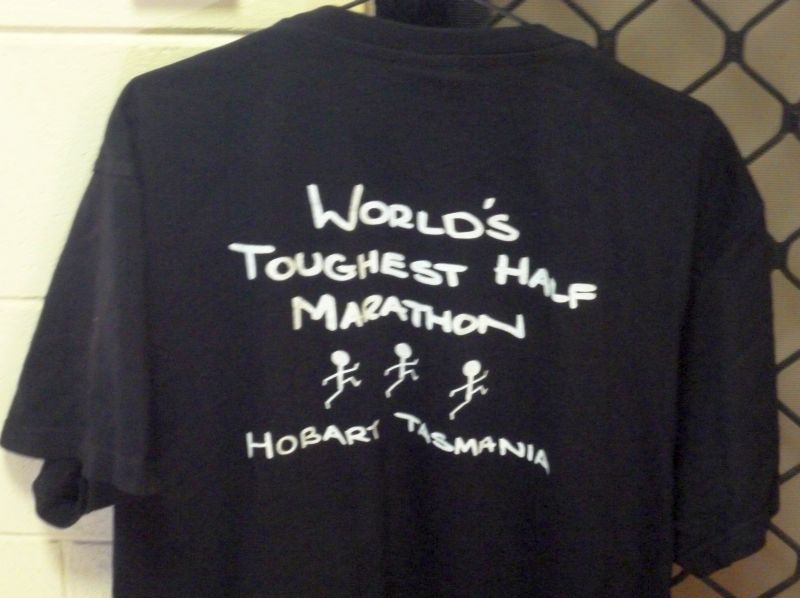
The shirt did say it all….
There was half a consideration to enter this event last year, but uncertainty over whether I can make the distance and a waning of interest after initial enthusiasm caused me to seek alternate events such as Run Sydney. This year however it was always in the pipeline, and I was lucky enough to register before spaces ran out. The event is so popular and limited in capacity (I learned there’s only so many buses that could transport the competitors back from the finish line) that even though the event is held in November the field is generally full by mid September. This year the WAITING LIST was full by that time, and the field itself was finalised at the end of August. The lesson here is to get in early and to not to wane on commitment to get to the start line.
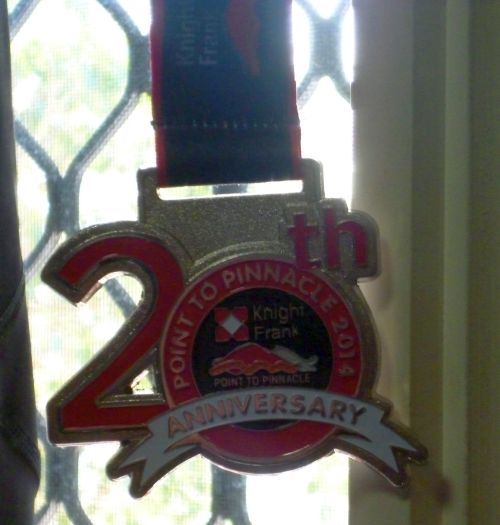
But the rewards….
This year was the 20th anniversary of the event, or as discovered at the pre-event dinner the 20th anniversary of the modern event. Just after the turn of the 20th century there was a run where competitors got to a certain point of Mount Wellington, then had to find their own way to the pinnacle as opposed to following a set path. Of the 20 runners that started, everyone made it to the top but only 18 made it back home with runners also needing to make their way back home. It was a nice event even though the food was a little dry (as opposed to post race recovery where the pumpkin soup hit the spot), and having John Maclean aboard to speak was a masterstroke. The value of persistence is what I’m sure many took away from his words of wisdom based on his life experience.
So to race morning, where despite the forecast of ordinary weather there was little wind and no rain to greet everyone at the Wrest Point Casino car park. Hopefully this was a good sign of things to come once on the mountain. The format of the event meant that the walkers started an hour ahead of the runners, and the walkers had to indicate upon entry if they were going to walk rather than run. The rules also indicated that they could walk, and only walk as opposed to runners who could run and walk as needed. It’s just another unique element to the event, for even though there was an overall time limit to complete the course (4.5 hours for the walkers, an hour less for runners), although the thrill of the chase isn’t exactly a major reason to complete this event.
After the walkers took their time to leave the start house, the usual pre-race routine kicked in with a dynamic warm up and gear drop (as you saw from the last post here, I decided to actually carry my camera along for the ride this time), although this was followed by a few group warm ups prior to the start. At almost precisely 8AM, the start hooter sounded and just over 1200 hardy souls were sent on their way.
It struck me on my first impressions of Hobart (given I had never ventured that far South in my life before) that the city had more elevation changes than I had experienced or imagined. There really wasn’t any stage where the course was purely flat, particularly before the last 12km climb up the mountain itself. Thankfully the training regime involving running up hills and even Mt Archer on three occasions put me in good stead. When asked in the weeks after the event by some colleagues, I joked that of the 21km event 19 of those were uphill, and the other 2 were basically downhill runs leading up to the next hill before approaching Mt Wellington.
Just after the 10km marker is the Pillinger Drive corner, a hairpin right that leads you onto the climb itself. But it wasn’t until you reach a part of the course known as The Springs where the mountain starts to take a toll. By this time we had caught up to the main body of the walking brigade so at least if the gradients became too much to bear we had decent company to have a chat to. Surprisingly it wasn’t until the 13km marker where I had to activate a plan I had set after my first training run up Mt Archer which was a smaller climb with a higher average gradient, take the mountain minute by minute. In other words it was a case of run for a minute then walk for a minute, which was the plan for many others as well. As you saw with some of the stills in the video, it was worth taking a moment to check out the views, just to give you an idea of how high we were climbing.
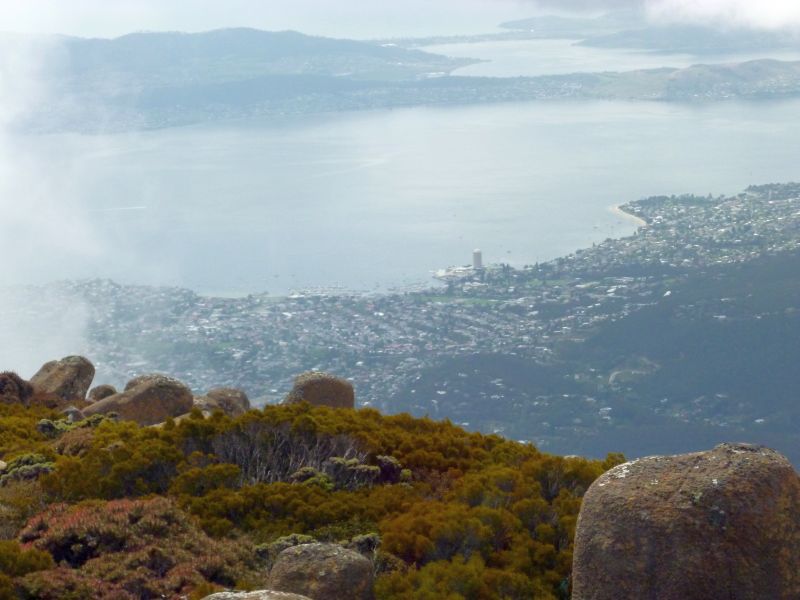
…and the view at the finish line were worth it
I started to feel a little seedy towards the latter stages of the climb, although my explanation for this wasn’t the altitude or tiredness but rather not being used to drinking water on the route as opposed to just sports drinks. It wasn’t until the 14km drink station that Gatorade was available which is different to many flat course events where there are fewer water only stations. It was also taking on board jelly lollies which I hadn’t done since the previous year on any race that may have made me feel ordinary. However by that stage not only could I smell the summit amongst the mist, I was well ahead of the schedule that I had set myself in terms of time.
Within the final kilometre I saw some buses ferrying the early finishers back to the Wrest Point, which at least spurred me on to run the last few hundred metres. Around the last bend were the “Mo Bros” (Movember being the official charity of the event), which at least dubbed me Ben Hudson given the beard was still intact and I was wearing Western Bulldogs kit (one of 4 clubs “The People’s Beard” played for). And not long after came the finish line, not too dissimilar to how some mountain stages at the Tour de France finish. As I walked towards the lookout to collect medals and refreshments I’m sure the on course commentators made mention of me wearing the zinc cream on a day where covering up usually was done with fabric, but I wasn’t exactly listening.
For once time didn’t matter to me as much as it usually would for half marathons. For what it’s worth I was hoping just to complete the course, and to finish under 2 hours 40 minutes would have been a great result. To learn that I finished in a tick over 2:21 pleased me, even more so after discovering the night before that Hawthorn coach Alastair Clarkson completed the same course in 2007 a minute slower. The time almost made being in the winds at the top bearable, but getting a seat on the bus and into the warmth was just what the doctor ordered.
Thus ends not only the hardest event I’ve ever done (and hopefully it won’t be the last time I’ll compete here), but also all the commitments for 2014. It certainly doesn’t mean I won’t be busy, there’s a 2015 schedule to create and sometime during December I’ll make sure this blog will have the details. Plus I’ll remain training lightly just to keep in some sort of shape.
 MHJeffrey027 Running